
ESG Thrives When Collaboration Bridges Generations, Geographies, and Sectors


Introduction
Environment, Social, and Governance (ESG) thrives when collaboration bridges generations, geographies, and sectors. The challenges ESG seeks to address climate risk, social inequity, and governance failures are inherently systemic. Their solutions require interconnected efforts that cut across age groups, regions, and industries. When youth leadership, grassroots community action, and institutional governance converge particularly in critical sectors like water utilities, renewal energy etc., which ESG transforms common goals and join action into a living ecosystem of shared purpose and collective impact. Let us elaborate three matters in the following,
Youth are pivotal
They are both present actors and future right-holders. Research across dozens of countries finds that students and young professionals already assign high importance to the SDGs, translating this awareness into pro-ESG knowledge, attitudes, and behaviour especially when supported by learning ecosystems and accreditation pathways. Youth networks mobilize rapidly across borders, reframing ESG as an everyday practice (e.g., circularity, energy saving, responsible technology) rather than a corporate niche. Thus create programs like the Youth Leadership & ESG Certification cultivates the next generation of sustainability leaders. By combining formal ESG education with actionable certification, it ensures young professionals are prepared to drive meaningful change across global and local contexts. Academic research underscores Generation Z, in particular, demonstrates stronger alignment between environmental ESG (E-ESG) and organizational commitment retention, indicating that young people gravitate toward purpose-driven sustainable employers.
Communities anchor ESG in place.
Studies of community-based sustainability initiatives show that the quality of relationships trust, reciprocity, and shared problem-framing often predicts success more than the number or type of actors involved. Place-based organizing surfaces practical know-how (e.g., water stewardship, waste reduction, flood adaptation), strengthens local identity (“sense of place”), and converts ESG from external compliance into lived benefits. The grassroots efforts, demonstrate how local communities translate ESG principles notably the Sustainable Development Goals (SDGs) into collective action. These locally rooted strategies build resilient, inclusive economies that reflect cultural values and needs. In addition, studies on bottom-up community empowerment anchored in local wisdom highlight its effectiveness in attaining ecological, social, and economic sustainability. Broader analyses show how structured community empowerment programs serve as pivotal tools in managing sustainable transformation. Methodologies like Asset-Based Community Development (ABCD) further emphasize leveraging local assets and strengths rather than external deficits aligning perfectly with ESG ideals of self-determination and equity.
Institutions provide the enabling architecture
Governments, companies, universities, and utilities supply governance, finance, data, and durability. Research on collaboration demonstrates that structured cross-sector partnerships with shared metrics, backbone support, and transparent accountability are more likely to generate durable public value and attract investment. This is significant because meta-analyses of 2,000+ studies, shows stronger link ESG performance to non-negative, and often positive, corporate financial performance reinforcing the business case for institutional participation. Case studies such as American Water Works demonstrate how ESG reporting especially on GHG emissions and water management can shape stakeholder trust and operational transparency. This represents vital infrastructure that is deeply entwined with environmental stewardship, governance, and social equity. Other research emphasizes tailored ESG metrics and frameworks like the Water Research Foundation’s initiative to design utility-specific ESG tracking systems highlighting the need for industry-specific adaptation
ESG frameworks aim to reshape how organizations, communities, and systems create sustainable value. The Steptra approach is rely on active interaction between Youth ESG Leadership, Community Empowerment and Institutional ESG as describe in the following figure,
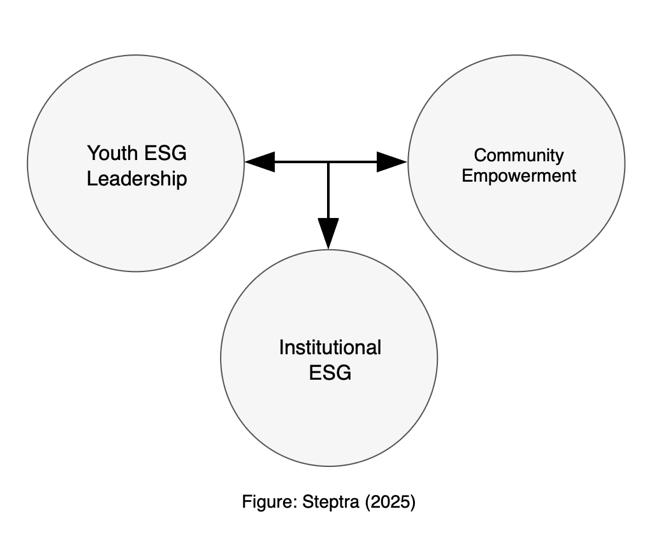
Bringing together young changemakers, place-based communities, and formal institutions aligns three powerful capabilities: future-oriented imagination, local legitimacy, and rules/resources at scale. Collaborations that braid these roles across cities, regions, and sectors are best positioned to turn ESG from policy language into measurable, investable outcomes whether that’s accelerating just energy transitions, advancing water resilience, or building inclusive local economies.
Conclusion
ESG flourishes when collaboration bridges generational, geographic, and sectoral divides. It is an invitation not only to policymakers and corporations, but also to youth, communities, and institutions to co-create a future where sustainability is global in intention yet local in action.
Small steps taken today create bigger impacts in the future !